Dzylo vs ClickUp vs Notion vs Monday.com:
Why Interior Businesses Need More Than Project Management
Published On: 30 June 2026
The interior design industry is unlike any other. Behind every beautifully designed space lies a complex network of client interactions, quotations, procurement processes, vendor coordination, site execution, payments, and inventory management.
As businesses grow, many teams naturally turn to popular platforms like ClickUp, Notion, and Monday.com to bring structure to their work. These tools have transformed how teams collaborate, assign tasks, and track progress.
But here’s the question: Can a project management tool truly support the way an interior business operates?
Great Project Management Tools
For What They Were Built To Do
There’s no denying that ClickUp, Notion, and Monday.com are powerful platforms.
- ClickUp is loved for its flexibility and extensive customization. Teams can build workflows, automate repetitive tasks, and manage projects across departments.
- Notion has become the go-to workspace for documentation and collaboration. It combines notes, databases, and project tracking in a clean, adaptable environment.
- Monday.com stands out for its visual approach to work management, offering intuitive boards, dashboards, and automation that teams can quickly adopt.
For startups, marketing agencies, software teams, and many service-based businesses, these tools are often more than enough.
But Interior Businesses Don’t Just Manage Projects
An interior business isn’t simply a collection of tasks.
The journey begins long before execution starts.
It starts with a lead.
A prospective client reaches out. Conversations begin. Requirements are gathered. Quotations are created and revised. Once approved, procurement planning kicks in. Vendors are contacted, materials are sourced, inventory is checked, teams are coordinated, and site execution begins.
Throughout this process, clients expect regular updates, management teams need visibility, and every delay can impact timelines and profitability.
Suddenly, the questions businesses need answered become much bigger:
- Which inquiries are converting into projects?
- Has the quotation been approved?
- Are procurement activities on track?
- Which vendors are delayed?
- Is inventory available?
- What stage is the project currently in?
- Are teams aligned across departments?
These are not just project management concerns.
They are business operations concerns.
The Hidden Cost of Using Multiple Tools
Many interior businesses try to make generic project management tools work for them. Projects are tracked in one place, quotations are managed in spreadsheets, procurement updates sit in separate files, vendor conversations happen over WhatsApp or emails, and inventory is maintained elsewhere. It works for a while—but as the business grows, keeping everything in sync becomes a challenge.
Initially, it works. As the number of projects grows and teams get bigger, things start becoming harder to manage. The same information gets updated in multiple places, important details can slip through the cracks, and pulling together reports often turns into a manual task. Teams end up jumping between different tools just to understand what’s happening, making it difficult to get a clear picture of the business.
Ironically, the very tools introduced to improve efficiency can begin creating friction when they’re stretched beyond their intended purpose.
Enter Dzylo: Built for the Business of Interior Design
Dzylo was created with one simple belief:
Interior businesses deserve software designed specifically for the way they work.
Instead of stitching together multiple platforms, Dzylo brings the entire workflow into one connected ecosystem.
From the moment a lead enters the pipeline to the final project handover, businesses can manage everything in a single place.
With Dzylo, teams can handle:
- Lead and inquiry management
- CRM and client communication
- Quotations and proposals
- Project planning and execution
- Procurement workflows
- Vendor coordination
- Inventory management
- Team collaboration
- Real-time reporting and visibility
The result isn’t just better organization.
It’s fewer manual processes, greater accountability, faster decision-making, and a smoother experience for both teams and clients.
So, Which Platform Should You Choose?
The answer depends on what your business truly needs. If your goal is simply to organize tasks and improve team productivity, ClickUp, Notion, and Monday.com are exceptional choices. They’ve earned their reputation for a reason.
But if you’re running an interior business and juggling clients, quotations, procurement, vendors, inventory, and execution simultaneously, your needs extend beyond task management.
You don’t just need to manage projects. You need to manage the entire operation.
That’s where Dzylo makes the difference.
Project management is important. But for interior businesses, it’s only one piece of a much larger puzzle. Success depends on how effectively you connect sales, procurement, execution, inventory, vendors, and client relationships into a seamless workflow.
ClickUp, Notion, and Monday.com help teams manage work.
Dzylo helps interior businesses run better. Because designing exceptional spaces requires more than completing tasks—it requires complete operational visibility from start to finish.
And when your business is built around bringing visions to life, the software behind it should be built with the same intention.
They offer features such as:
- Task management
- Team collaboration
- Status tracking
- Documentation
- Project timelines
- Workflow automation
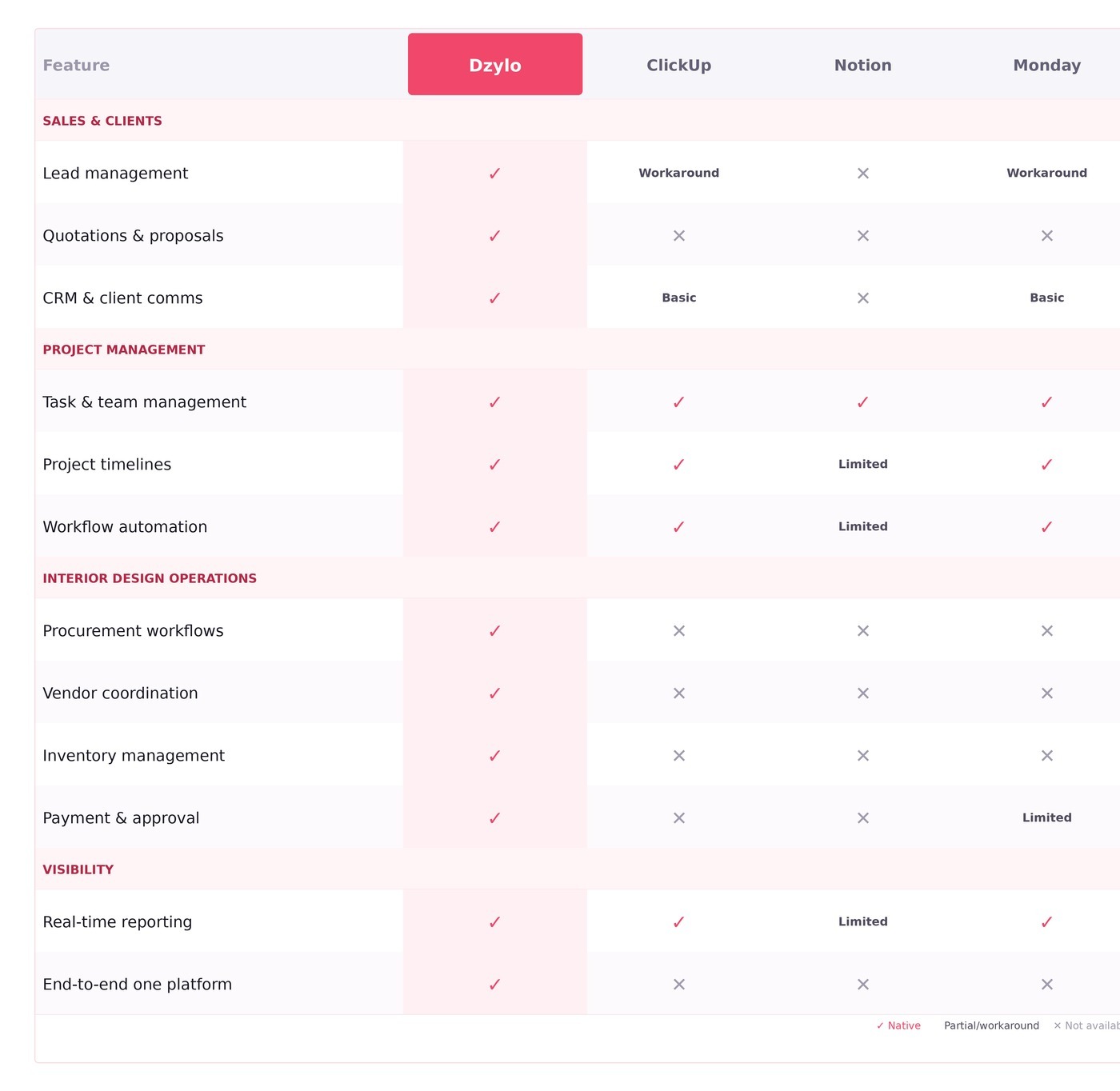
For software companies, marketing agencies, and general business operations, these tools work extremely well. However, interior businesses operate differently. An interior project doesn’t end with assigning tasks. It involves:
- Managing inquiries and converting leads
- Preparing detailed quotations
- Coordinating with multiple vendors
- Tracking procurement activities
- Monitoring inventory and material usage
- Managing site execution
- Handling client communication
- Tracking payments and approvals
Trying to manage these processes through generic tools often leads to fragmented workflows, multiple spreadsheets, and endless manual follow-ups.
Ready to run your interior business with greater clarity and control?
Visit Dzylo.ai to discover how you can manage leads, quotations, procurement, projects, inventory, and collaboration—all in one place. Because your business deserves more than just project management.